announcing sift’s $42M series b funding. read more.

Codify engineering limits as rules, run them on live telemetry and historical data, and open the investigation with one click. Astrolab and Reliable Robotics detect anomalies in real time on Sift.
“Sift spared us from heavy internal tool investment and unified our data management. It provides a complete stack that's intuitively accessible, plus we get an advanced, supportive team behind it, so it really wasn't a question for us.”

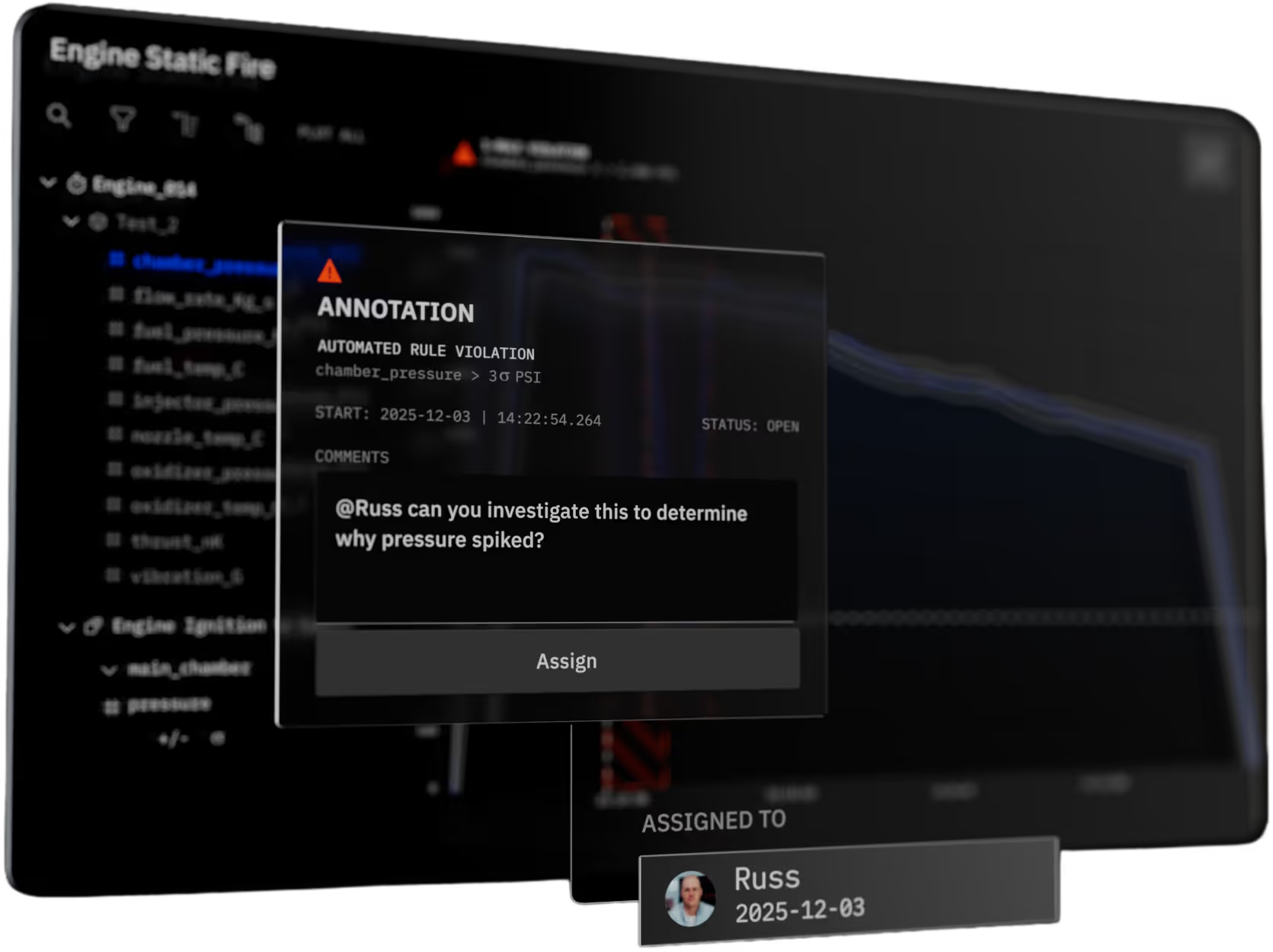
Rules are named the way you describe the hardware, so a finding reads as a diagnosis. "Sustained motor overheat" tells you what the engine did before you ever look at the plot.

.png)
Define limits directly from your ICD: voltage bounds, pointing-error thresholds, rolling drift alarms, and conditions composed across channels, state transitions, and derived values. If you can describe it, you can write it without touching a DSL or config file.
Run any rule against live telemetry and historical test data in the same pass, with no rewrites and no drift between environments. What you prove on the bench is what protects you in production.
When a rule fires, the finding carries the channel, the timestamp, the triggering condition, and a direct link into the plot with the cursor parked on the exact moment. One click moves from alert to investigation.
.svg)
Astrolab's engineers codify review criteria as Sift rules, turning senior engineer judgment into automated checks that run against every rover test campaign. The Rules feature has saved $100k+ by surfacing anomalies that would otherwise have slipped through manual review and forced a rework cycle downstream.

Reliable Robotics runs Sift's rules engine on the same telemetry streams that feed their flight certification process, catching anomalies in real time during autonomous flight testing. The rules engineers wrote in dev run unchanged in the certification environment, preserving the institutional knowledge that carries the program through regulatory review.
Write rules the way engineers describe the hardware: thresholds, state transitions, derived channels, rolling statistics. No PromQL, no custom DSL, no stapling a log query to a metric query to approximate a physics condition.
Every rule evaluates live telemetry and historical runs through the same code path. Write a rule today and Sift runs it across every past test in the program. Regression coverage comes free with the rule.
Anomalies surface with panel, timestamp, rule, and metadata attached. One click opens the plot. One more opens the investigation. Detection, triage, and root cause share one surface.